

Your leads may still be coming in, even when your reports say they are not. In 2026, the implementation of Google Consent Mode v2 is one of the primary reasons Google Ads, GA4, and CRM numbers stop lining up for lead gen sites.
Google’s June 15 shift, which was heavily influenced by the Digital Markets Act and the ongoing need for strict GDPR compliance across EEA and UK territories, made consent settings the gatekeeper for ad data. A small configuration mistake can now cut measurement, weaken automated bidding, and hide real conversion paths. The first job for any marketing team is to distinguish between genuine demand loss and these persistent consent mode reporting gaps.
Key Takeaways
- Google tightened Consent Mode in 2026, and missing signals now accelerate data loss, making accurate ad measurement significantly more difficult.
- Lead gen sites feel the pain more because small conversion counts make every hidden lead matter.
- Basic Consent Mode blocks data by default, while Advanced Consent Mode enables essential modeling for denied users.
- The biggest blind spots show up between Google Ads, Google Analytics 4, call tracking, and CRM revenue reporting.
- Better reporting starts with consent audits, weekly checks, and dashboards that separate observed from modeled conversions.
Why 2026 created bigger reporting gaps
Before 2026, many teams treated Consent Mode as a privacy layer. Now it is also a performance layer. The rollout of Google Consent Mode v2 moved advertising data control squarely into this framework, which is why the June 2026 Consent Mode update matters far beyond compliance teams.
Lead generation websites get hit harder because the funnel is narrow. You might only need 20 qualified leads a month to hit a goal. If five of those disappear from reporting, the account can look weak even when sales are healthy.
The setup now depends on four specific consent signals, not two. While ad_storage and analytics_storage remain the foundational consent signals, your implementation, which usually happens via Google Tag Manager, must account for all four. If your CMP or tag configuration sends only part of the set, Google often treats the missing fields as denied.
| Consent signals | What it controls | What breaks when it is missing |
|---|---|---|
ad_storage | Ad cookies and identifiers | Google Ads data collection drops |
analytics_storage | Analytics cookies | GA4 behavior reporting becomes partial |
ad_user_data | Hashed user data to Google Ads | Enhanced Conversions and audience signals weaken |
ad_personalization | Personalized ads and remarketing | Remarketing lists and related bidding signals drop |
A lot of current reporting loss comes from the last two fields. Teams updated for earlier versions, then never finished the Google Consent Mode v2 setup. As a result, Enhanced Conversions, audience signals, and remarketing can fail for unconsented EEA users even when forms still work.
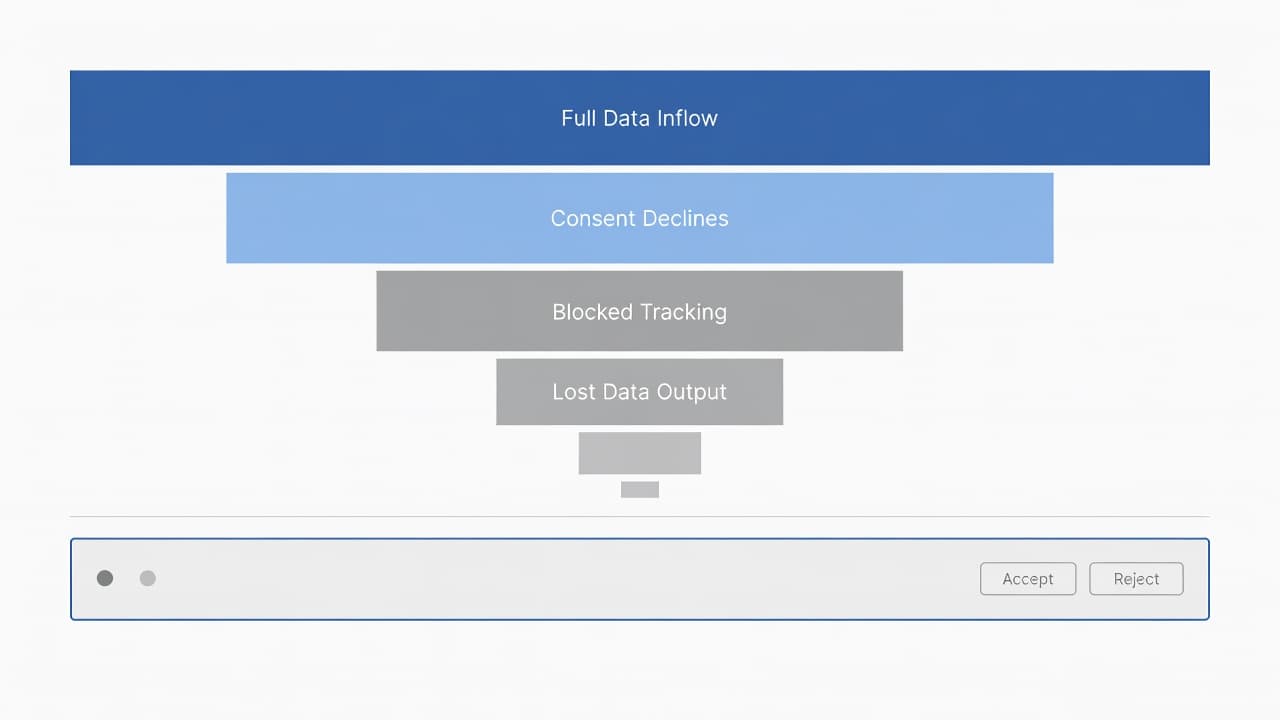
Basic Consent Mode also creates a hard limit. When tags stay blocked after denial, Google gets no cookieless pings, so it has nothing to model. Advanced Consent Mode sends those cookieless pings without cookies or personal data. These cookieless pings allow Google to generate modeled data, giving the platform a way to estimate part of the missing conversion path.
Later in 2026, Google will move even more personalization control to ad_personalization. That means half-finished setups will keep losing ground.
Where lead gen teams lose sight of the funnel
The first blind spot sits between observed and modeled conversions. Raw reports do not show denied-user activity the way many marketers expect. Instead, GA4 behavioral modeling works to bridge these gaps. These modeled conversions appear in your summaries and segments, even while granular, user-level detail remains limited.
This creates confusion fast regarding attribution accuracy. A media manager sees fewer tracked form fills, yet sales sees booked calls holding steady. Leadership often assumes campaign quality has dropped, even though it is the measurement infrastructure that has changed. Much of this depends on your Google Analytics 4 settings, specifically your choice of reporting identity. By utilizing a blended reporting identity, you can see modeled data alongside observed data to get a clearer picture of performance.
Lead gen sites also rely on long handoffs. Someone clicks an ad, reads a page, calls later, then closes offline. If consent blocks ad identifiers or data sharing, the later revenue may never match back to the original click. Your CRM records the win, but Google Ads cannot learn from it.
If your banner blocks tags without Advanced Consent Mode, denied users do not disappear only from cookies. They also disappear from conversion modeling.
Across digital marketing teams, the fallout also reaches SEO, performance marketing, social media marketing, and website development. Landing page tests, form changes, call tracking, CRM imports, and server-side rules all affect what survives the reporting chain.

There is a second blind spot in channel evaluation. Google Search Console can show impression and click shifts, but it does not show lead quality by itself. That is why teams need GA4, phone tracking, and CRM stages side by side. When consent loss hits, the funnel does not break in one dashboard. It breaks across several.
This matters for GEO and AEO too. As AI answers and zero-click search reduce some visits, every tracked session carries more weight. If your reporting loses consented and unconsented paths at the same time, budget decisions get noisy fast.
How to fix the setup before blaming the channel
Start with the consent stack, not the ads. A lot of lead gen accounts are still running cookie banners or tag templates that never fully caught up with Google Consent Mode v2 requirements. Using a certified Consent Management Platform like Cookiebot, OneTrust, Didomi, Axeptio, or Usercentrics usually makes this easier, but templates still need manual review after any platform updates.
Then check your tag order within Google Tag Manager. The default consent state should fire before marketing tags, usually through Consent Initialization. Most teams also use a wait_for_update window of around 500 milliseconds so your Consent Management Platform can load before tags decide what data they may send.
A fast audit should confirm five things:
- Your site sends both consent default and consent update events.
- All four consent signals are present.
- Google Ads diagnostics show Consent Mode as active and modeling as eligible.
- GA4 data streams show ads measurement and personalization consent signals as active.
- Your banner changes, template releases, and geo settings are logged in one place.
For a deeper checklist, the GA4 consent split audit is a useful comparison point, and this guide on Consent Mode v2 and revenue impact is helpful when stakeholders only care about pipeline loss.
Weekly monitoring matters because consent rate has become a working KPI. A 70 percent EEA consent rate leaves a smaller modeling gap. At 30 percent, bidding often runs on thin data and lead volume looks weaker than reality.
This work also needs one source of truth. If analytics, paid media, and dev teams keep separate notes, small mismatches linger for weeks. Many brands handle that inside broader digital marketing solutions for growth because consent now touches media buying, analytics, and site code at the same time.
If your tags, CMP, and CRM still disagree after an audit, Get In Touch With Us before you change bids or pause campaigns. Treating these technical fixes as a foundational element of your privacy-first marketing strategy will ensure your data remains robust despite changing regulations.
Reporting for SEO, GEO, and AEO when data is partial
Once the setup is clean, the reporting model needs to change. The old habit of staring at platform conversions alone is no longer enough for lead generation.
Build dashboards that separate observed data from modeled data. Split these metrics by region, device, and landing page when possible. This approach helps you spot whether data loss stems from low consent rates, page friction, or a broken integration. Relying on conversion modeling is essential here, as it provides a necessary bridge when your tracking data is incomplete.

Next, push quality signals back into ad platforms through transaction reporting. Cost per lead is too shallow when measurement is partial. Booked call rate, qualified lead rate, sales-accepted lead rate, and closed revenue tell a more accurate story. Offline conversion imports help because they reconnect media data to outcomes that happen after the user submits a form.
Your website still carries more weight than many teams admit. Clear CTAs, short forms, and strong message match reduce the number of missed opportunities that are often incorrectly blamed on reporting gaps. For many service businesses, a form asking only for name, phone, service, and ZIP code converts better and loses less data to friction.
Organic visibility also becomes more valuable when paid measurement gets thinner. Strong landing pages, visible business details, and accurate schema help AI search systems understand your identity and offerings. If you want traffic that does not depend on ad identifiers, B2B SEO services for qualified leads become easier to justify because they add first-party demand that your Google Analytics 4 property can track reliably.
Clean reporting for GEO and AEO follows the same rule as clean reporting for paid media. Make the page facts obvious, keep schema aligned with visible content, and track what turns into real conversations rather than just vanity clicks.
Frequently Asked Questions
How does Advanced Consent Mode differ from Basic Consent Mode regarding data loss?
Basic Consent Mode completely blocks tags if a user refuses consent, resulting in zero data capture for that visitor. Advanced Consent Mode allows tags to fire in a cookieless state, sending pings that enable Google to generate modeled data and recover estimated conversion paths.
Why do my Google Ads reports show fewer leads than my CRM records?
This mismatch often occurs because consent settings can block ad identifiers, preventing Google from connecting a form submission back to the original ad click. When these signals are missing, the CRM accurately records the lead, but Google Ads cannot attribute that success to your marketing campaigns.
What are the four mandatory consent signals required for version 2 compliance?
To maintain full functionality, your implementation must account for ad_storage, analytics_storage, ad_user_data, and ad_personalization. Missing any of these signals, particularly those added in version 2, can lead to degraded audience lists and weakened bidding signals within your Google Ads account.
How can I verify that my consent setup is working correctly?
You should regularly check your Google Ads diagnostics to ensure Consent Mode is marked as active and that modeling is eligible. Additionally, verify that your Google Tag Manager configuration fires consent defaults before marketing tags and that all four required signals are correctly passed from your CMP.
Conclusion
Lead gen reporting in 2026 breaks less from bad traffic than from bad visibility into the traffic you already have. Consent mode reporting gaps hide conversions, distort attribution, and teach bidding systems the wrong lesson.
The strongest fix is not flashy. It is a clean four-signal setup, Advanced Consent Mode, and the adoption of Google Consent Mode v2, which has become the new baseline for lead generation. Coupled with weekly audits and revenue reporting that connects Google Ads, GA4, calls, and CRM stages, you can effectively bridge the data divide.
When your dashboards admit what is observed and what is modeled, decisions get calmer. Prioritizing attribution accuracy helps you maintain control, ensuring that your team can protect performance and continue to thrive in a privacy-first marketing landscape.