

A busy phone line can still hide a revenue problem. If leads pile up but calendars remain thin, your lead to booked job rate is telling you where the gap sits.
For local home services businesses, more traffic is rarely the full answer. You need to know which inquiries fit your service area, receive a prompt response, and turn into scheduled work, all while optimizing your broader lead generation and lead conversion rate to ensure low-quality lead volume is never mistaken for true growth.
Key Takeaways
- Most home service teams should target a 40% to 60% booking rate from inbound calls, depending on how calls are counted.
- Website visitors and total inquiries need separate benchmarks because each sits at a different point in the funnel.
- Track qualified leads, booked estimates, sold jobs, lost reasons, and overdue leads in the same CRM view.
- Poor speed to lead, unclear service-area rules, and weak follow-up often hurt your conversion rate more than wasted ad spend.
- Compare booking performance by channel, job type, location, and dispatcher before changing your marketing budget.
Lead to Booked Job Rate Benchmarks by Funnel Stage
The lead to booked job rate measures the percentage of leads that become scheduled appointments, estimates, or service visits. The formula is simple:
Booked jobs / qualified leads x 100 = lead-to-booked-job rate
However, the denominator matters. A rate based on all form fills will look lower than one based only on qualified, answered inquiries. A plumbing company that receives 100 calls, reaches 70 callers, qualifies 50, and books 25 jobs has several useful rates, not one universal number.
Published 2026 benchmarks show broad ranges because service type, urgency, lead source, and scheduling capacity differ. Still, these ranges give owners a practical starting point.
| Funnel measure | Typical performance | Strong performance |
|---|---|---|
| Website visitor to lead | 3% to 8% | 10% to 12% |
| Inbound lead to booked job | 15% to 35% | 40%+ |
| Answered home service call to booking | 40% to 50% | 50% to 70% |
| Contractor total inbound calls to booking | 40% to 60% | 60% to 70% |
| Referral lead to booked job | 40% to 70% | Varies by fit and availability |
| Plumbing qualified lead to paying customer | 20% to 40% | Above 40% |
Home service call data often places the middle ground near 42% to 46% for call-to-booking. Contractor call-center benchmarks describe 40% to 60% of total inbound calls as healthy. These figures include a mix of calls that may be missed, out of area, price-shopping, or unrelated.
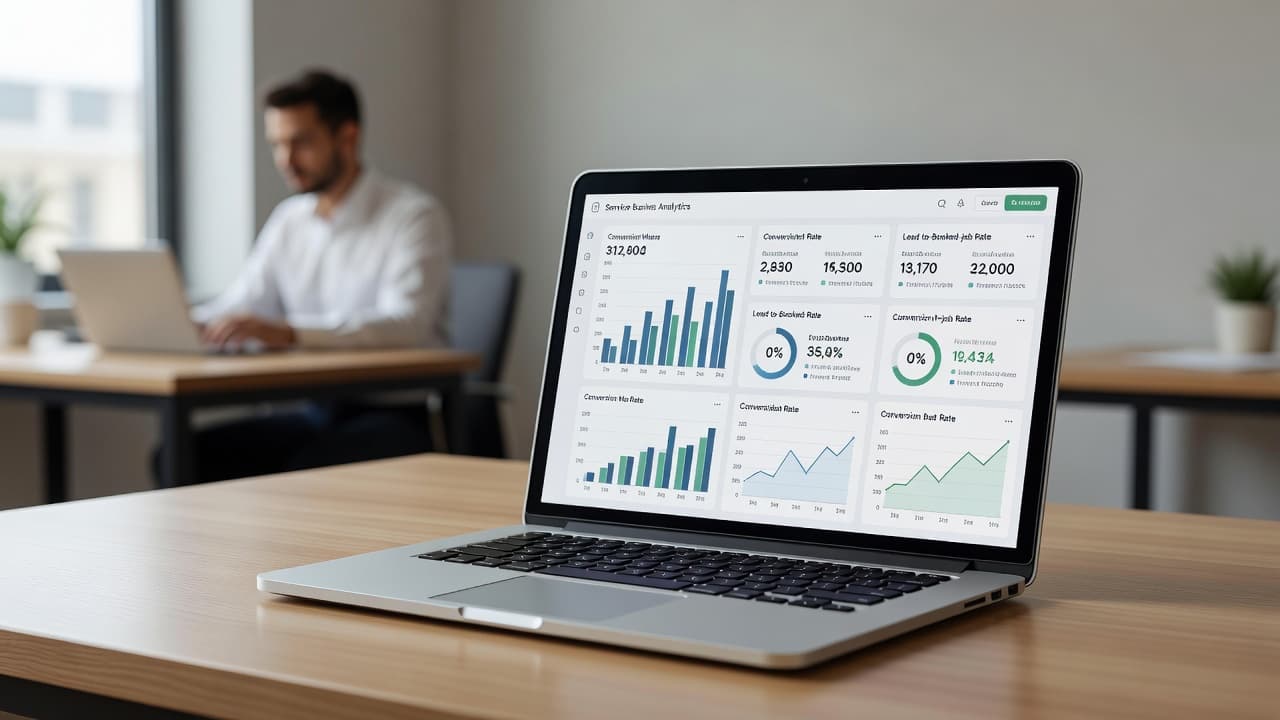
A 25% rate may be excellent for a general contractor handling large renovation projects. The same number would be concerning for an emergency HVAC team with live phone coverage and same-day availability. Match your benchmark to the buying situation.
A booking rate cannot diagnose a problem until you separate unqualified inquiries, missed contacts, estimate follow-ups, and genuine customer refusals.
Source quality changes the picture, too. When operating in competitive home services markets, your overall lead conversion rate often depends on whether you purchase exclusive leads or shared leads. Referrals often convert far better than paid social clicks because trust and intent arrive before the first conversation. Search ads for “emergency plumber near me” can also convert well, while broader social campaigns may create more early-stage questions than appointments.
These differences directly influence your cost per lead and your final cost per booked job across every campaign.
Measure the Lead to Booked Job Rate Without Distorting It
Start with clear stage definitions. Every team member must use the same rules, or the dashboard becomes a collection of opinions. This requires a consistent lead qualification process across your entire team.
A lead is a new inquiry with contact information. A qualified lead fits your service area, job type, and basic availability requirements. A booked job has a confirmed date or time window. A sold job has accepted the estimate or completed service.
For many service companies, the most useful monthly scorecard includes:
- Total leads and duplicate or spam inquiries
- Qualified lead rate and contact rate
- Consultation or estimate booking rate
- Proposal-to-sale rate and lead-to-sale rate
- Median first-response time and SLA breach rate
- Lost reasons, overdue lead count, and booked revenue
Review the numbers by source. Google Ads, Local Services Ads, organic search, referrals, and social platforms produce different intent levels. A campaign with fewer leads may deserve more budget if it supplies booked work at a dependable cost.
For example, Google Ads can report ten form conversions while the CRM shows only three qualified leads. That gap may come from duplicate forms, bad-fit searches, location errors, or a landing page that promises a service you don’t provide. Keep call tracking, form tracking, and CRM dispositions connected.
When possible, send qualified leads, booking, and closed-revenue signals back to Google Ads. Google click identifiers such as GCLID and WBRAID can help match offline outcomes to paid clicks. By tracking these deeper conversions rather than just obsessing over your initial cost per lead, you protect your customer acquisition cost and secure a much healthier return on investment because the platform learns from work that your team accepted, not only from form submissions.
Monthly reviews should lead to a decision. Remove an irrelevant search term. Add a service-area exclusion. Update a landing page promise. Put another dispatcher on late-afternoon coverage. Give estimate follow-up a clear owner.
Find the Break Between Inquiry and Appointment
A weak lead to booked job rate does not automatically mean your lead generation failed. Find the first stage where performance slips.
Low contact rate often points to missed calls, slow replies, incorrect phone numbers, or poor routing. Emergency repair leads can go cold within minutes, making speed to lead a critical metric. Monitor the median response time, not only the average response time, because a few forgotten inquiries can disappear inside a decent-looking average.
High contact but low booking usually calls for a closer look at call handling and service fit. Dispatchers need enough information to set expectations, identify urgency, and schedule the next step. They should not sound scripted. A simple question such as, “Is the leak active right now?” helps an HVAC or plumbing team prioritize the request.
Strong booking but weak sales is often a friction point in the overall sales process. Track proposal turnaround time, financing availability, price objections, and the effectiveness of your follow-up sequence after the visit. Larger jobs may need several contacts over several days, while an emergency repair needs immediate scheduling.
Poor performance from one landing page can mean message mismatch. An ad promising same-day furnace repair should lead to a page that repeats the service, city, response window, phone number, and proof near the top. A general homepage adds unnecessary work for a person who needs help today.
Short forms reduce friction, but they still need useful qualification fields. For many local businesses, name, phone, requested service, and ZIP code are enough. Include service-area limits, minimum job requirements, or pricing context when those facts prevent unsuitable requests.
A strong 90-day service business SEO plan can improve lead quality by aligning location pages with real services and real coverage areas. Rankings only help when the page sets an honest expectation before the phone rings.
Improve Booking Rates With Better Handoffs and Better Pages
Set a response standard that fits the job. Emergency services need a near-immediate call back during open hours. Quote requests for remodeling or commercial work can follow a planned follow-up sequence of calls, emails, and reminders. Every new lead should have an assigned owner and a scheduled next action.
Use a daily queue for open and overdue leads. Then audit a sample of calls, texts, and form responses each week. Check response speed, accuracy, tone, appointment handling, and whether staff selected the right outcome in the CRM.
Marketing and operations must share the same promise. If you can’t offer same-day service, don’t imply it in ads or on a service page. If you work only in selected ZIP codes, say so before the form. Honest qualification can improve lead quality, raise your lead-to-booked-job rate, and increase job profitability.
Your website also has a major role. Digital marketing begins where visitors decide whether your business feels credible and easy to contact. SEO can attract high-intent searches, Social Media Marketing can introduce the brand, and Website Development determines whether a mobile visitor can act without hunting for a number.
Build high-intent service pages that improve lead quality and include:
- A headline that matches the service and location searched
- A visible phone number and booking option above the fold
- Clear service-area details, hours, licenses, warranties, and online reviews
- Short answers to cost, scheduling, and availability questions
- FAQ and local-business schema where it accurately reflects the page
These details also support SEO, GEO, and AEO. Clear headings, direct answers, consistent business information, and accurate service descriptions help search engines and AI answer tools understand who you serve.
Keep your Google Business Profile, website, and major citations aligned. A wrong phone number or outdated hours can waste leads before a dispatcher gets a chance to respond. Local visibility works better when every customer-facing source gives the same details, which is part of a sound local SEO strategy.
If google ads produce leads that don’t fit, tighten geography, negative keywords, job-type language, and landing-page copy before cutting marketing spend. Reallocating ad spend alongside a focused demand generation strategy for service businesses connects acquisition targets with the capacity to answer, qualify, and schedule real customers.
Frequently Asked Questions
What is a good lead to booked job rate for home service businesses?
Most home service teams should target an inbound call booking rate of 40% to 60%. However, benchmarks vary widely depending on your industry, lead source, and whether the inquiry is an emergency service or a long-term project.
Why are my website leads not turning into booked jobs?
Low conversion rates often stem from a slow speed to lead, unclear service-area rules, or a message mismatch between your ad and landing page. Checking your CRM data helps pinpoint whether the drop happens during initial contact, qualification, or estimate follow-up.
How does lead quality impact my cost per booked job?
Exclusive, high-intent leads—such as referrals or targeted search ads—typically convert at a much higher rate than cheap shared leads. Improving lead quality lowers your overall customer acquisition cost and ensures your team spends time on prospects who actually fit your business.
Turn Benchmarks Into Profitable Decisions
The best lead to booked job rate is not the highest possible percentage. It is a reliable rate built on accurate tracking, qualified demand, prompt contact, and service capacity your team can meet.
Compare your results against the right funnel stage, then inspect the exact loss point. Improving your booking rate works together with your overall close rate and average job value to generate sustainable revenue, meaning a 10% improvement here can create more growth than another month spent chasing traffic that never receives a timely reply.
Fixing your conversion gaps also yields a lower customer acquisition cost and stronger return on investment across all marketing channels. If your marketing data and CRM outcomes tell different stories, Get In Touch With Us to review the handoff, tracking, and conversion gaps.