

If you’re losing calls to competitors in your own service area, it often isn’t because they’re better. It’s because they have better local visibility, looking more trustworthy in the places customers decide fast: Google Maps, the local pack, and “best of” pages.
A local seo competitor audit turns that frustration into a repeatable workflow. You’ll learn who’s winning, why they’re winning, and what to copy (ethically) with clear priorities.
This guide focuses on local search engine optimization for service businesses in 2026, plumbers, HVAC, dentists, electricians, cleaners, law firms, and local teams supporting them.
Why a Local SEO Competitor Audit matters more in 2026
AI image prompt: Service business owner analyzing Google map pack rankings and local SEO metrics on a laptop in a modern home office, realistic photo, natural light, no readable text.
Local search feels more crowded in 2026 because AI search means more actions happen before a website click. People tap to call, compare photos, skim reviews on Google Business Profile, then book. As a result, your audit can’t stop at “who ranks.” It has to explain what makes Google and customers trust them.
Also, results vary by where the searcher stands. A law firm can dominate local search rankings downtown but disappear in a nearby suburb. So you need a workflow that’s location-aware and consistent.
If you want another perspective on what a modern local audit includes, first verify your own performance in Google Search Console and complete a technical SEO audit to ensure basic site health. Then compare your notes with this local SEO audit guide and keep only what maps to revenue.
Treat your audit like a pre-flight check. You’re not collecting facts, you’re preventing lost leads.
Step 1: Start your competitor analysis by building your competitor list (the right way)
AI image prompt: Marketer creating a local competitor list from Google results using a laptop and notepad at an organized desk, realistic photo, soft light, no readable text.

Start with your main services and your real service area. Then search in incognito and on mobile when possible. Add competitors from both the map results and the organic search results, because you’ll often see different brands in each.
Keep two buckets:
- Revenue competitors: businesses that actually take your jobs (even if they don’t rank well yet).
- Search competitors: the ones that show up for your money terms.
For example, an HVAC company should track long-tail keywords that match search intent, like “emergency AC repair,” not just “HVAC contractor.” Meanwhile, a dentist should add “Invisalign” and “teeth whitening” if those drive high-margin bookings.
Aim for 5 to 10 competitors. More than that slows decisions.
Step 2: Audit Google Business Profiles like a buyer, not a marketer
AI image prompt: Top-down view of a laptop comparing two Google Business Profiles on a clean desk with notes, photorealistic, natural light, no readable text.
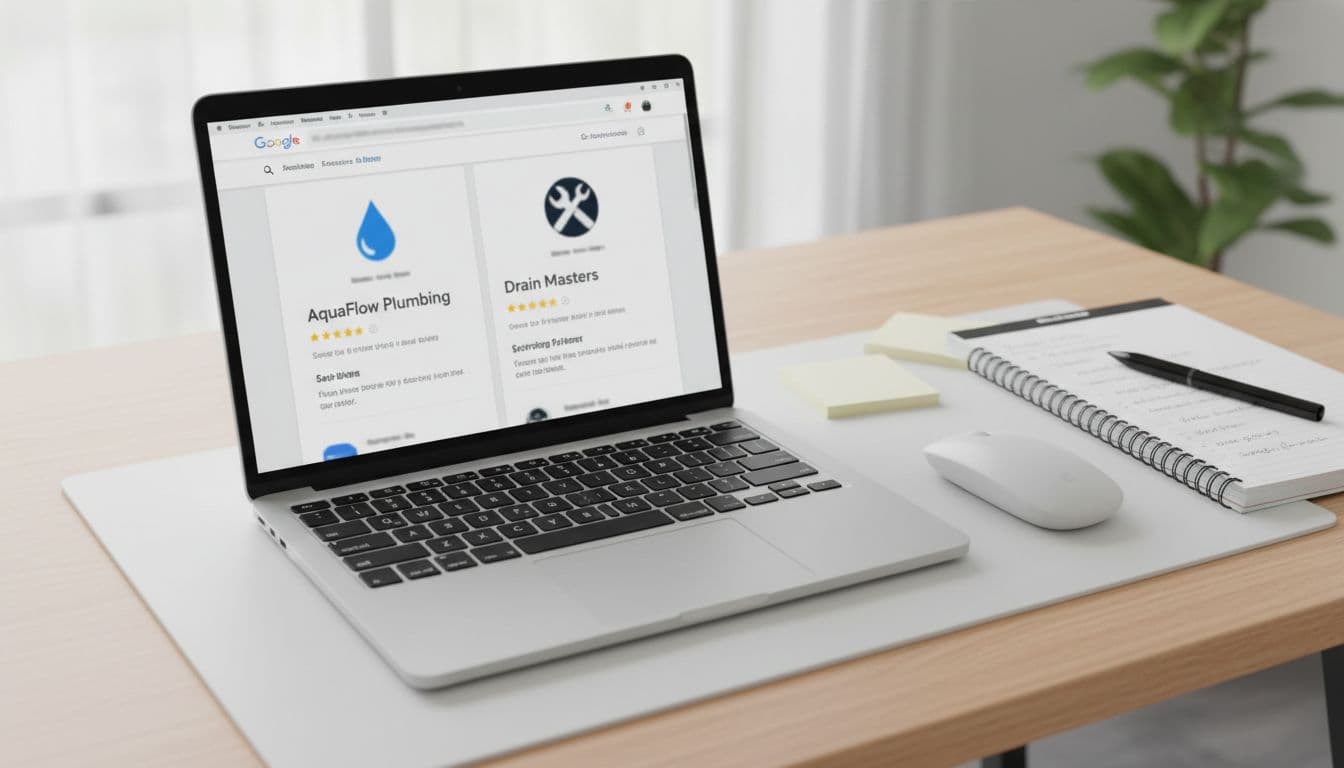
Now open each competitor’s Google Business Profile and capture what a customer can see in 10 seconds. You’re looking for patterns, not perfection.
Focus on:
- Primary category and secondary categories: do they match the service you want to rank for? Check the business information for accuracy, and see if competitors may be using schema markup to help Google verify their Google Business Profile data.
- Services list: are they thorough and written in customer language?
- Photos: do they look real, recent, and local?
- Posts: are they active enough to signal “open and responsive”?
- Messaging, booking, and call-to-action: do they reduce steps?
If your own Google Business Profile feels “complete,” it still might not compete. Use this as a benchmark, then tighten your setup with ClickyOwl’s Google Business Profile Optimization guide.
Step 3: Check local pack and organic rankings across real locations
AI image prompt: Smartphone showing a Google local pack map result next to printed rank notes on a desk, realistic photo, bright window light, no readable text.
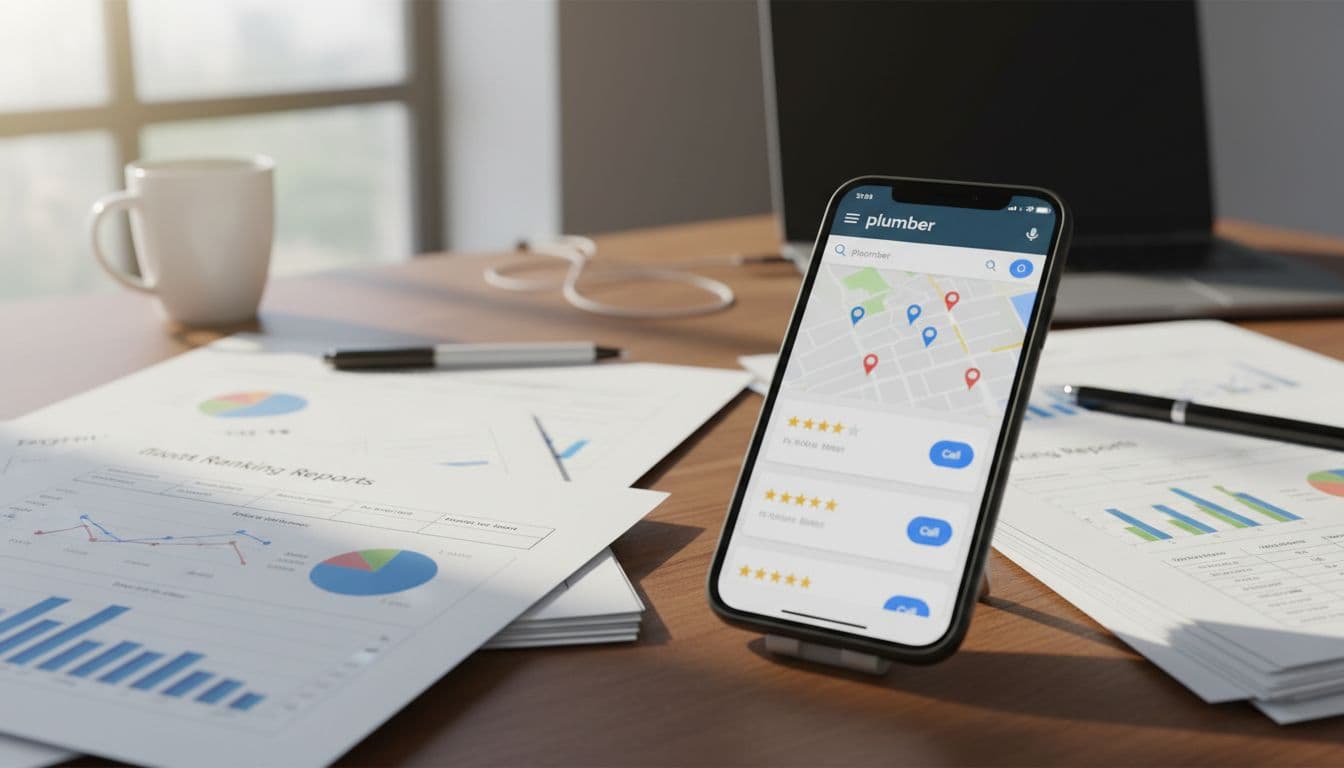
Local search rankings aren’t one number anymore. They shift by neighborhood, device (perform a mobile audit to verify), and wording. So, pick 3 to 5 “grid points” that match where you want customers. Track the local pack and the same core terms at each point.
For keyword research, practical examples:
- Plumber: “emergency plumber,” “drain cleaning,” “water heater repair.”
- Dentist: “dentist near me,” “emergency dentist,” “Invisalign.”
- Law firm: “personal injury lawyer,” “car accident lawyer,” “free consultation.”
Also note who wins the “people also ask” and who owns the organic pages under the map. When you find gaps, you’ll feed them into your content plan. ClickyOwl’s Local SEO Keyword Research Template helps you turn those terms into a clean page map.
Step 4: Examine competitor websites for local intent, proof, and coverage
AI image prompt: Laptop showing a blurred website audit view with an on-page checklist notebook beside it, warm light, photorealistic, no readable text.
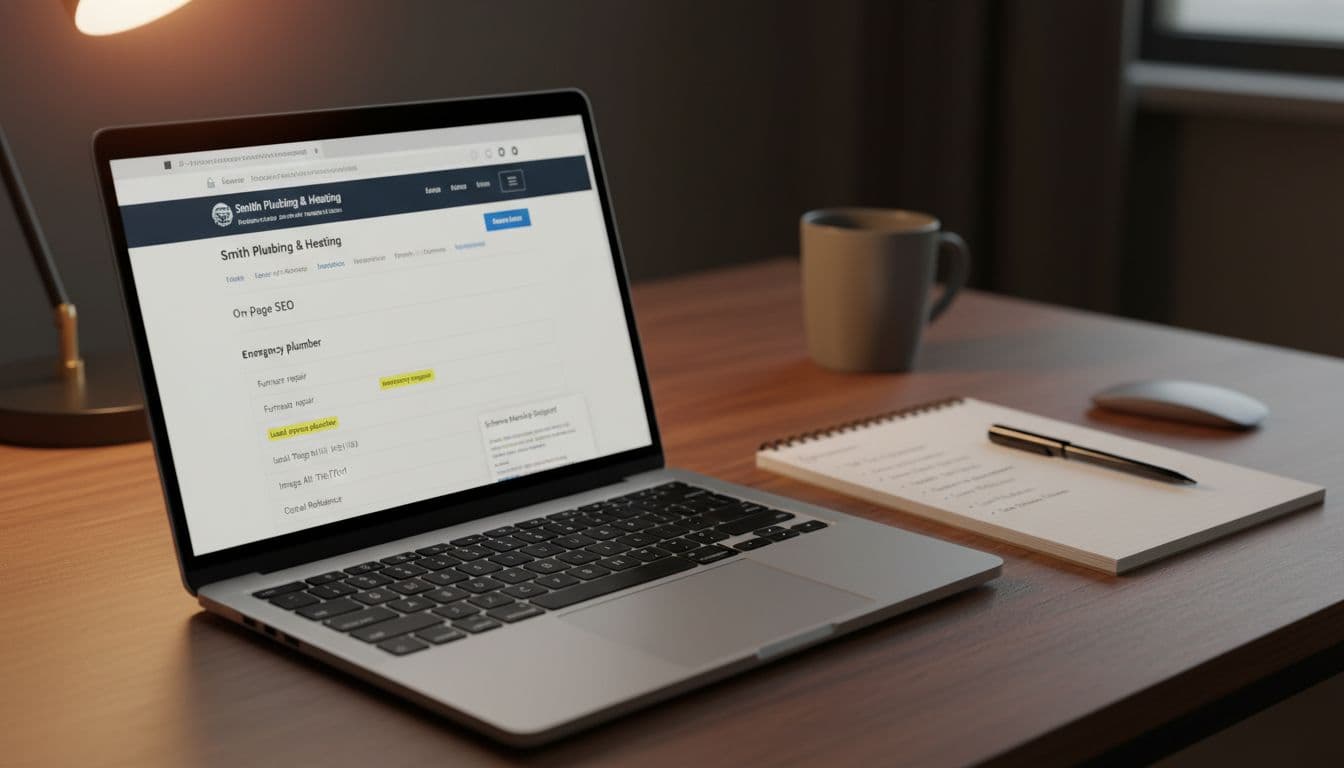
Competitors often win because their site answers buyer questions faster. So, for each top competitor, conduct a local content audit by reviewing the pages that rank for your target terms and write down what they do better.
Look for:
- Service page depth: pricing ranges, process, timelines, warranties, FAQs.
- Location coverage: city pages, neighborhood pages, “areas we serve” clarity (especially for multi-location businesses).
- Proof: case photos, licenses, insurance, awards, staff bios, before-and-after (cross-check with Google Business Profile for added trustworthiness, as these proof points boost conversion rates).
- Conversion flow: click-to-call, quick forms, clear service-area statements.
A cleaning company might win with simple proof like “bonded and insured” plus real job photos that align with its Google Business Profile. On the other hand, a dental clinic often wins with provider credentials and financing details close to the top of the page.
Step 5: Analyze reviews, citations, and local links for trust signals
AI image prompt: Tablet displaying review trends and citation audit visuals with backlink graphs on a desk, diffused light, realistic style, no readable text.
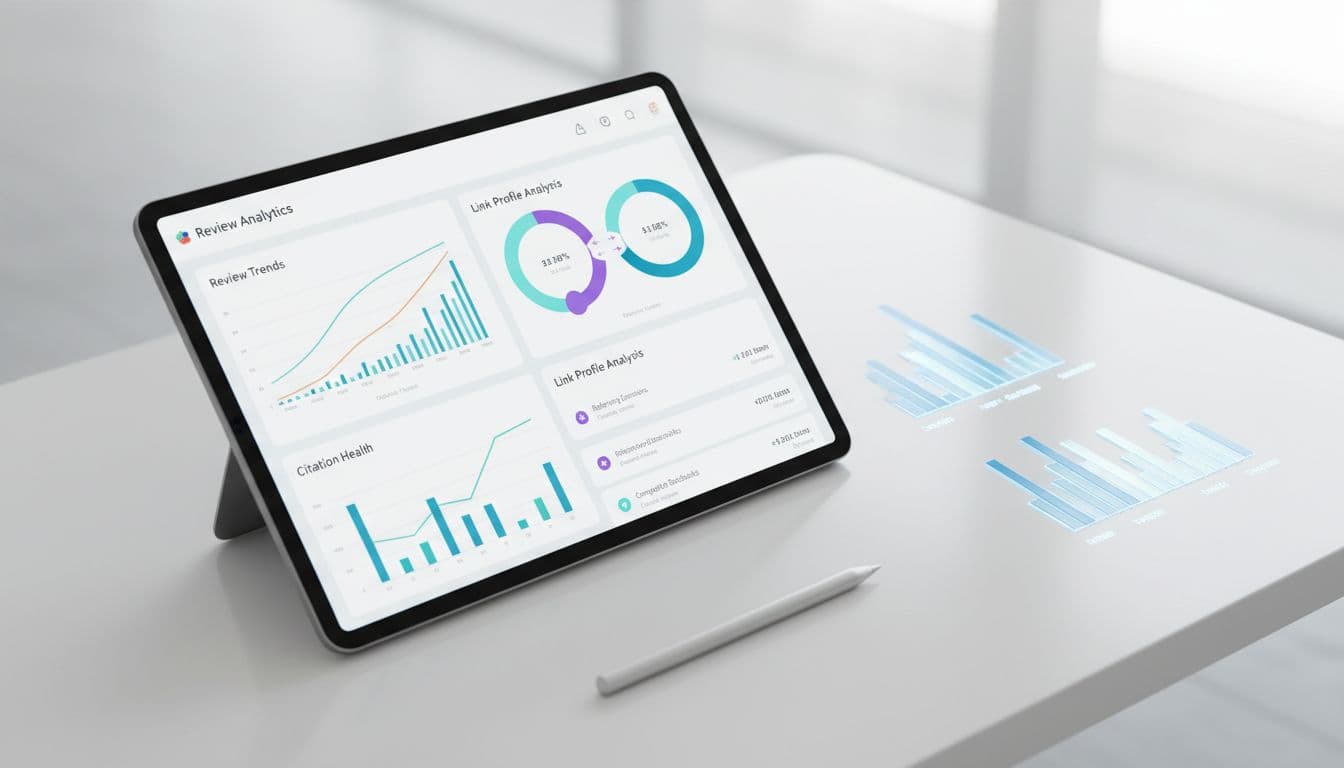
This is where “prominence” gets real. Two businesses can look similar, yet one has stronger trust signals across the web.
Start with online reviews:
- Compare online review count, rating, and review frequency.
- Scan wording. Do customers mention the services you want to rank for?
- Check owner replies. Fast, calm replies often correlate with higher conversions.
Next, citations and local backlinks:
- Verify nap accuracy across key directory listings, and check citation consistency in directory listings.
- Note local backlinks from chambers, local news, sponsorship pages, supplier lists.
For more competitive-analysis framing, this local SEO audit and competitive analysis overview lays out the categories worth measuring.
A competitor with fewer online reviews can still beat you if their online reviews match high-intent services and stay fresh.
Step 6: Turn findings into a simple action plan (with copy-friendly checklist)
AI image prompt: One professional highlighting gaps in a competitor analysis sheet in a conference room with a whiteboard of action sketches, realistic photo, bright light, no readable text.

Don’t try to “fix everything.” Instead, score each gap by impact and effort, then ship the top few improvements this month. Turn your competitor analysis findings into competitor intelligence that powers a simple action plan. A good local SEO competitor audit ends with a short sprint, not a long wish list.
Copy this copy-friendly competitor analysis checklist into a doc or sheet and fill it for your top 3 competitors:
| Competitor analysis area | What to capture | Where to check | Your notes |
|---|---|---|---|
| Competitor set | Top 5 to 10 real competitors | Google Maps + organic search results | |
| Google Business Profile basics | Categories, services, attributes | Google Business Profile | |
| Google Business Profile activity | Photos, posts, Q&A, booking, messaging | Google Business Profile | |
| Local search rankings | Map pack and organic by neighborhood | Manual checks, rank tracker | |
| Service pages | Depth, proof, CTAs, FAQs | Competitor websites | |
| Local visibility | Cities, suburbs, neighborhoods served | Competitor websites | |
| Online reviews | Count, recency, themes, replies | Google reviews | |
| Directory listings | NAP accuracy, key directories | Major directories | |
| Local backlinks | Sponsorships, local PR, associations | Backlink tools, Google | |
| Competitor analysis next actions | 3 quick wins, 3 bigger projects | Your plan |
Then tailor your action plan by niche. For example, plumbers usually win with faster response messaging, emergency service proof, and review velocity. Dentists often need stronger provider pages and service-level FAQs. Law firms tend to benefit from location-focused practice pages and local news mentions.
If you want help building and executing the plan, ClickyOwl’s Local SEO Services page outlines what a fully managed workflow can cover.
Wrap-up: your competitors aren’t mysterious. They’re leaving clues everywhere. Run this workflow quarterly, refresh the checklist monthly, use Google Search Console to track the impact of your local search engine optimization improvements, and you’ll keep finding winnable gaps that turn into calls.